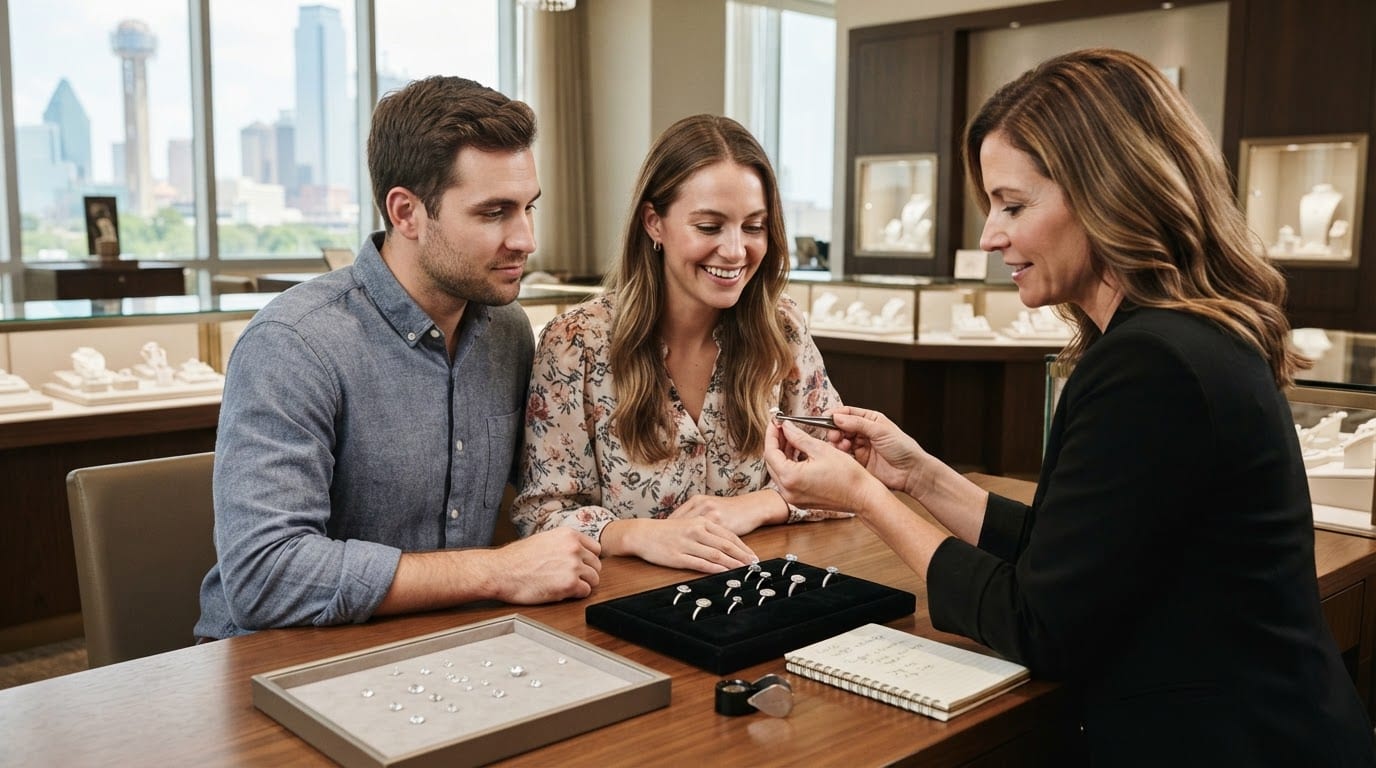
Few jewelry purchases carry as much emotional weight, or as much confusion, as an engagement ring. Buyers often arrive with a budget in mind, a vague sense of what their partner likes, and a stack of online images that all look different. The decisions that matter most, including how the money is divided, how the ring will be sized, and how the stone will be graded and documented, rarely get the attention they deserve. Careful planning at each stage tends to produce a ring that still looks right and still fits years later.
Buyers in the Dallas-Fort Worth area have a wide range of options, from traditional showrooms to independent designers and custom workshops. Shopping for engagement rings in Dallas means comparing not only stones and styles but also how each store handles repairs, documentation, and resizing after the sale. Those services matter more than most buyers expect.
For a jeweler’s perspective on how sales conversations often unfold, a firm like Shapiro Diamonds is a useful reference point when comparing consultation approaches, though buyers should evaluate any store against the same criteria.
Set a Budget That Accounts for the Full Ring
The center stone usually absorbs most of the budget. Diamond prices rise steeply with carat weight, and a modest increase in size can move the price of a stone far more than the cost of the metal or the setting. Mounting, labor, and metal are typically priced separately, so the final cost of a ring depends on the stone and the design together.
A practical starting split for a mined-diamond ring with a standard four-prong or six-prong setting looks something like this:
- Center stone: roughly 65 to 80 percent of the total
- Setting and metal (14K or platinum): roughly 10 to 20 percent, with custom CAD design and hand-fabrication pushing this higher
- Side stones, pavé, or a halo: 5 to 15 percent, depending on the number and size of accents
- Matching band: often planned separately, typically several hundred to a few thousand dollars
Platinum is denser than 14K gold and costs more per gram, so the metal choice can shift a setting’s price noticeably. A custom piece with a fabricated shank, a hidden halo, or a bespoke pavé pattern can add significant labor charges. Buyers should ask for each line item to be itemized so they can see where the money goes.
Many buyers choose a smaller center stone now and plan an upgrade later, often at an anniversary. This approach works best when the setting is designed with the future stone in mind. Requesting a prong and gallery configuration that can accept a larger stone, or a mounting that can be re-tipped, can save money later. Ask the jeweler whether the design can be upgraded without replacing the entire setting.
Texas sales tax also belongs in the budget. Dallas has a combined sales tax rate of 8.25 percent, so a quoted price should be confirmed as either tax-inclusive or tax-exclusive before a deposit is paid.
Read the Partner’s Taste Without Giving Away the Surprise
Style signals are often visible in everyday choices. Pay attention to the metal color of jewelry the partner already wears. Someone who consistently wears yellow gold is unlikely to be happy with white metal, and the reverse is also true. Note preferred silhouettes as well: delicate, minimal pieces suggest a different ring than bold, sculptural ones. Clothing and lifestyle cues, such as a preference for vintage pieces, an active outdoor life, or a formal professional wardrobe, can also shape a design that will feel natural to wear every day.
Information can be gathered discreetly. Casual window-shopping, where the partner is invited to look at jewelry without any commitment, reveals more than direct questions. Asking a close friend or family member is another reliable route, since they often know specific preferences about stone shape, setting height, and metal. Keep these conversations low-key and avoid anything that could tip off the partner.
Buyers also face a tension between a customized ring and a ring the partner would have chosen. A custom design can reflect the relationship in a personal way, but it carries the risk of a miss. A ring that is close to a partner’s taste but not exact is easier to fix than one that was designed from scratch around a guess. Stock designs with a few adjustable details, such as metal, stone shape, or halo style, often offer the best balance. If a wrong guess is made, a stone can usually be reset into a new setting, and a metal can sometimes be refinished, though both steps add cost and time.
Plan Ring Size and Design Together
Ring size should be measured by a professional, not guessed. Sizes vary by country, and a finger can change temperature, time of day, and season. A jeweler can measure with a ring mandrel or sizing gauge, and can take multiple readings if the finger is unusually shaped or has been affected by swelling. Many buyers borrow a ring from their partner’s collection, but a worn or stretched band may not match the current measurement. Measuring a ring the partner wears on the correct finger, then having it confirmed by a jeweler, is more reliable.
Design and size must be decided together. Eternity bands, full-eternity settings, and certain halo designs are harder to resize or cannot be resized at all. A full-eternity band is set with stones around the entire circumference, so enlarging it means breaking and rebuilding the setting. Some halos are built around a shank that limits how much the ring can be adjusted. A jeweler’s sizing advice can shape the design before the stone is selected. For example, if the partner’s measured size is at the upper end of a common range, a jeweler may recommend a design with a flexible shank or a setting that can be resized within a small range. Those constraints should inform the stone choice, not the reverse.
Compare Stone Options and Visual Size
Natural and Lab-Grown Diamonds Side by Side
Natural and lab-grown diamonds share the same chemical composition, crystal structure, and optical behavior. Both measure 10 on the Mohs hardness scale, the highest rating, and both can be graded using the same 4Cs framework of cut, color, clarity, and carat weight. The main differences lie in origin, price, and resale.
Lab-grown diamonds are produced through high-pressure, high-temperature (HPHT) growth or chemical vapor deposition (CVD). Both methods start from a diamond seed. Lab-grown stones are typically priced well below comparable mined stones, though the gap varies by size, color, and clarity and has shifted considerably in recent years. Natural diamonds generally hold a stronger resale market, while lab-grown diamonds have a more limited secondary market and lower resale value. Buyers who expect to resell a ring should understand that most jewelry, including mined diamonds, sells for less than its retail price.
Regardless of type, verify origin and grading. A diamond should come with a report from an independent laboratory such as GIA (Gemological Institute of America) or IGI (International Gemological Institute). The report should identify whether the stone is natural or laboratory-grown and list its measurements, cut grade, and inscription number. Ask the jeweler for the report before purchase, and match the inscription on the stone to the document. Graded stones are not automatically better than ungraded ones, but documentation is the only reliable way to compare two stones.
Common misconceptions deserve plain answers. Lab-grown diamonds are not imitations or simulants like cubic zirconia or moissanite. They are real diamonds. Natural diamonds are not automatically more valuable as a symbol, and buyers should decide based on priorities such as budget, origin preferences, and long-term resale expectations.
Making a Center Stone Look Larger
Carat weight alone does not determine how large a stone appears. A well-cut stone with a larger face-up diameter can look bigger than a deeper stone of the same weight. Cut proportions, table size, and depth all affect visual size.
A halo is a ring of smaller stones surrounding the center diamond. It increases the apparent diameter without a large price increase and is compatible with most shapes. The trade-off is profile. A halo raises the head of the ring and can change how the setting sits against a band, and it can make the ring feel bulkier. Buyers who wear rings daily should check comfort and snagging risk, particularly with pavé-set halos.
Elongated shapes, such as oval, pear, and marquise, often look larger than round stones of the same weight because they spread across more of the finger. Side stones, often called three-stone designs, also increase finger coverage, though they add cost and require more careful setting work. Each option has trade-offs. A pear shape may need a protective setting for its pointed tip, while a three-stone design may draw attention away from the center stone if the side stones are too large.
Evaluate Dallas Jewelers and Plan the Proposal
Vetting a jeweler should happen before any stone is chosen. A useful checklist includes:
- In-house repair capability, including sizing, stone resetting, and prong work
- Grading documentation from GIA, IGI, or another recognized laboratory
- A written return or exchange policy with time limits and conditions
- Clear, itemized pricing that separates stone, metal, and labor
- Documentation of any certifications held by staff, such as GIA Graduate Gemologist credentials
During a consultation, ask how custom work is timed and what happens at each stage. Custom CAD design, wax modeling, casting, stone setting, and finishing can take several weeks, and a delay in any step extends the timeline. Ask how resizing is handled, whether it is done in-house, and whether it affects the setting, especially if the design includes pavé or eternity stones. Also ask whether the store offers any warranty on setting security.
Aftercare is part of the purchase. Most jewelers recommend professional cleaning and inspection about every six months, including checks of prong tension and setting security. Between visits, clean the ring with warm water, a few drops of mild dish soap, and a soft-bristle toothbrush, then rinse and air-dry it on a lint-free cloth. Avoid harsh chemicals, chlorine, and abrasive cleaners, which can damage metal and loosen settings.
Lead time should be built in early. Custom work, resizing, and engraving can take weeks, and holiday periods and Valentine’s Day can extend production schedules. Starting the process at least two to three months before the planned proposal leaves room for revisions, sizing confirmation, and any unexpected delays.
Dallas-specific planning matters too. Summer temperatures often exceed 100 degrees Fahrenheit, so an outdoor proposal in July or August can be uncomfortable. Spring brings severe thunderstorms and occasional hail, which can alter plans for patio dinners or rooftop events. Holiday seasons in North Texas can be mild or cold, and a backup indoor location is worth having. Checking the forecast the week before an outdoor proposal, and confirming reservations for popular venues in advance, reduces avoidable risk.
