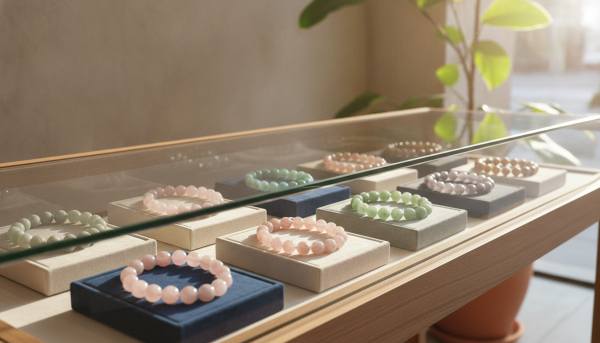
Picture yourself comparing a bracelet against a handful of loose stones, trying to work out which surface picks up marks first.
A search for a new age store near me will turn up plenty of choices, but the better move is to ask what mineral you’re holding and where it ranks before it goes on your wrist. Answer that, and you can judge how daily contact may affect the surface.
What Hardness Actually Measures
From 1, the softest, to 10, the hardest: that’s the Mohs scale, and it ranks resistance to scratching. Any mineral with greater relative hardness can scratch one ranked lower. Sorting loose stones before they go into jewelry means checking relative hardness early, often first.
Surface resistance is what hardness describes. It doesn’t measure every kind of wear a stone might face. It helps when you’re thinking through a bracelet rubbing against a watch, a desk edge, or another bead during ordinary use.
The Ten Reference Points
The U.S. Geological Survey’s mineral hardness reference lists the index minerals as talc at 1, gypsum at 2, calcite at 3, fluorite at 4, apatite at 5, feldspar at 6, quartz at 7, topaz at 8, sapphire at 9, and diamond at 10.
Those names give you a working ladder to compare against. Quartz sits at 7, making it a useful reference point between softer minerals like calcite and much harder materials such as sapphire or diamond.
Hard Isn’t the Same as Tough
Better scratch resistance is what a higher number can mean. It doesn’t promise that the stone will shrug off a sharp knock or a drop onto tile. Toughness is about how a material handles force; Mohs hardness is about whether the surface resists scratching, and those are separate questions.
Nor is the scale evenly spaced. The gap between two neighboring numbers doesn’t always represent the same change in scratch resistance, so read it as a relative ranking, not a ruler with equal marks.
A Practical Mental Benchmark
Please don’t test a shop’s inventory with household objects. A scratch test can mark a polished surface, and any seller worth buying from should be able to identify the mineral and explain where it sits on the scale.
For a mental reference, the National Park Service’s field guide to mineral hardness places a fingernail around 2.5, a copper penny around 3.5, knife steel or glass around 5.5, a steel nail around 6.5, and a masonry bit around 8.5. Comparisons like these are why two stones that look equally glossy may not handle surface contact the same way at all.
Wrist-Wear Checks
Comparing healing stones and crystals? Let your intended use drive the decision. A “new age store near me” search will help you find options, but it won’t tell you whether softer and harder materials will rub against each other every day.
- Will you wear the piece most days or only occasionally?
- Will it touch harder beads, a metal clasp, or a watch?
- Would light surface wear bother you over time?
- Can the seller name the mineral and place it roughly on the scale?
In Closing
Treat Mohs hardness as a starting point when you’re picking a stone for ordinary wear, nothing more than that. It speaks to scratch resistance. Toughness and your plans for the piece still matter once that bracelet meets a countertop or the inside of a bag.
Look at the stone you wear most often, then ask for its mineral name before you choose the next one. Could you say where it sits relative to the Mohs scale today?
